
Impact-as-an-API: How Climate Action Is Moving from ESG Reports to Code (2026)
Featured in Sustainable Business Magazine: corporate sustainability is leaving annual ESG reports and moving into the API calls that already run your business. Learn how Impact-as-an-API works, why the EU Green Claims Directive is forcing the shift, and the 6 most common per-transaction impact triggers (Stripe, Shopify, HubSpot, Salesforce).
As featured in
Sustainable Business Magazine
This piece expands on the analysis published in “From ESG Reports to API Calls: The Quiet Shift in Corporate Sustainability” — Sustainable Business Magazine's editorial on how corporate climate action is moving out of annual reports and into automated workflows.
What Is Impact-as-an-API?
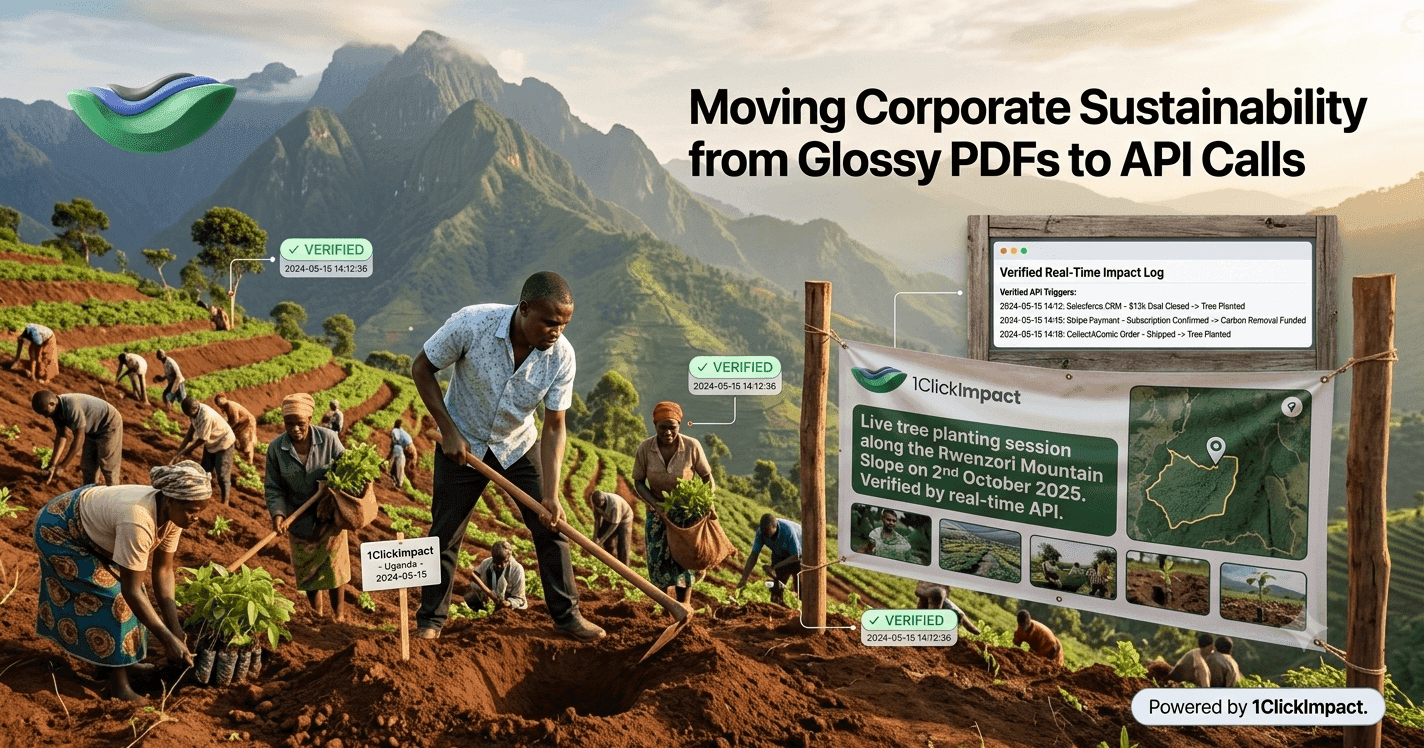
Impact-as-an-API is the practice of triggering a verified real-world environmental or humanitarian outcome — a tree planted, a kilogram of ocean plastic removed, a tonne of CO₂ captured, a meal donated — from a single REST API call or no-code automation. Instead of buying carbon credits in bulk and assembling an annual sustainability report, businesses fire one verified impact action per business event: a closed deal, a paid invoice, a shipped order, a five-star review.
The shift matters because it puts sustainability where every other business-critical function already lives: in the automation layer. Sales already runs through a CRM. Billing already runs through Stripe. Fulfilment already runs through Shopify. Until recently, climate action was the one corporate function still living in PDFs and Q4 marketing campaigns. That gap is closing — quickly.
TL;DR — Sustainability is becoming infrastructure. The companies that will win the next decade aren't the ones with the largest sustainability budgets. They're the ones that wire verified impact directly into their existing automation.
From ESG Reports to API Calls: What Actually Changes
The shift from glossy annual disclosures to per-transaction impact isn't cosmetic. It changes who owns sustainability, how it's measured, and how it's defended under audit.
| Dimension | The old model (ESG report) | Impact-as-an-API |
|---|---|---|
| Cadence | Annual ESG report | Per-transaction, real-time |
| Evidence | Aggregated narrative claims | Timestamped, per-action certificates |
| Owner | Sustainability / marketing dept. | Operations, engineering, finance |
| Procurement | Multi-year bulk credit contracts | Per-action, pay-as-you-trigger |
| Verification | Manual audit after the fact | Built-in MRV at the moment of action |
| Customer-facing | PDF report nobody reads | Live impact pages and shareable receipts |
How an Impact API Works in Practice
The mechanics are familiar to anyone who has wired a Stripe webhook or a Zapier zap. The destination is the only thing that's new.
Trigger
A business event fires — a Stripe payment succeeds, a HubSpot deal hits closed-won, a Shopify order ships, a Typeform is submitted.
API call
Zapier, Make, or your backend hits one REST endpoint: POST /plant-tree, /clean-ocean, or /capture-carbon.
Verified outcome
The action is executed by a verified project partner. A transaction ID, GPS coordinates (where applicable), and a digital certificate are returned in the response.
Real Use Cases — One Trigger, One Impact
Below are the six most common impact triggers we see across the 1ClickImpact customer base. Every one of them runs on existing infrastructure — no bespoke engineering required.
| Team | Business trigger | Impact action |
|---|---|---|
| Sales | Salesforce / HubSpot deal closed-won | Plant a tree per closed deal |
| Marketing | New HubSpot / Mailchimp lead | Donate a meal per qualified lead |
| Finance | Stripe / QuickBooks invoice paid | Capture CO₂ per paid invoice |
| Operations | Shopify / WooCommerce order shipped | Remove ocean plastic per order |
| Product | New user signup or subscription renewal | Plant a tree per active user |
| Customer success | 5-star review or NPS promoter | Fund ocean cleanup per advocate |

Wire your first impact action in under 5 minutes
Connect any of 6,000+ apps via Zapier, or call our REST API directly. No bulk contracts required.
Why Regulators Are Forcing This Shift
The technical evolution is arriving at exactly the moment vague sustainability claims are becoming legally indefensible. Three converging pressures:
- EU Green Claims Directive. Requires companies to substantiate environmental claims with auditable, scientific evidence. Aggregated annual narratives no longer qualify.
- UK CMA Green Claims Code. Bars unsubstantiated or misleading environmental claims in marketing. Per-action evidence is the cleanest defence.
- US FTC Green Guides revision. Sharper rules on carbon-offset and 'net-zero' claims, with enforcement actions against companies that can't prove specific impact per claim made.
Per-action, per-transaction impact is inherently defensible. When every meal donated, tree planted, or kilogram of plastic removed is bound to a specific timestamp and a specific business event, greenwashing becomes structurally difficult to pull off — there's no aggregate to hide behind. This is precisely the dynamic Sustainable Business Magazine highlighted in its recent editorial on the shift.
Greenwashing vs Verifiable Impact
The shorthand we use with customers — what to avoid, what to wire in instead.
Hard to defend
- “We're committed to net-zero by 2050”
- “A portion of every sale supports the planet”
- Bulk credit purchases reported once a year
- Sustainability tab buried in the footer
Audit-ready
- “One tree planted per order, GPS-tagged”
- “5 kg of ocean plastic removed per invoice paid”
- Per-action certificates with transaction IDs
- Live, public impact page
Make Sustainability a Side-Effect of Doing Business
Trigger verified tree planting, ocean cleanup, carbon capture, coral restoration, or food donations from any tool in your existing stack. One REST API. 6,000+ Zapier integrations. Per-action certificates baked in.
Frequently Asked Questions
The Bottom Line
Corporate sustainability is leaving the marketing department. It's becoming core infrastructure — a natural side-effect of doing business rather than a separate program competing for a slice of the quarterly budget. As regulation tightens and verifiable evidence becomes the baseline expectation, the organizations that win will be the ones that have wired impact directly into their automation layer.
That's the shift Sustainable Business Magazine called out in “From ESG Reports to API Calls”, and it's the thesis 1ClickImpact has been building toward since day one.
Ready to wire verified impact into your stack? Start at 1clickimpact.com.