
Ecosia AI and Ecosia Chat: Backlash, Energy Use, and the Off Switch
What Ecosia AI and Ecosia Chat run on in 2026, why longtime users objected, what one query costs in electricity and water, and how to turn it all off.
The search engine that plants trees now runs a chatbot. Three providers later, the energy bill is still unpublished.
trees Ecosia has planted, counted only after three years
model providers in three years: OpenAI, Mistral, then open weights
per chat on a small open-weight model, our median estimate
turns every AI feature off since July 2026
Ecosia is the Berlin search engine that spends its profits on trees. It passed 250 million planted this April, and it only counts a tree once it has survived three years. It also now puts AI Overviews above its results and offers a chatbot called AI Chat, and in the ten months since those launched it has changed model providers twice. A good share of its longtime users wanted none of it.
The short version
- Ecosia AI is two features: AI Overviews above the results, on by default in 13 countries, and an opt-in AI Chat that is still in beta.
- Users objected to default-on summaries, wrong facts with citations attached, mission creep, and a “greenest AI” claim with no energy figure behind it.
- Ecosia has never published what one of its AI queries costs. Our calculator puts a small open-weight chat model at about 0.046 Wh, against 0.456 Wh for a frontier model and 3.96 Wh for a reasoning model.
- Since July 2026 one setting, AI-free searching, removes Overviews, the chat entry points and auto-routing.
- On 6 October 2026 Ecosia said it is leaving Mistral, its provider since May, for open-weight models from Qwen, GLM and Kimi.
What is Ecosia AI?
“Ecosia AI” is the umbrella name for two features that launched on 2 December 2025, alongside a redesign of the whole site.
AI Overviews are a short summary placed above the regular results, with citations to the pages it drew from. They are on by default where available. Ecosia’s help center lists 13 countries, including the US, UK, Germany, and France, and says the summaries run on a Mistral Small 3.2 model served through Ecosia’s own European search index.
AI Search, which most people call AI Chat, is the conversational mode. It opens when you click the chat entry on a results page or in the navigation bar, and Ecosia still labels it a beta. For logged-in users it can also generate images through Black Forest Labs. Video generation, conversation sharing, and deep research are missing, and Ecosia says it left them out on purpose because they burn the most energy.
What is Ecosia Chat?
Ecosia Chat is older than the rest. Ecosia launched it in beta in December 2023, a few days before COP28, on OpenAI’s API. It had a “green answers” toggle that steered replies toward lower-carbon choices, such as a train over a flight. At the time, Ecosia told The Next Web that early testing put the extra emissions from the chatbot at about 5% of its footprint, and admitted it had no real oversight of the emissions behind a language model call.
The December 2025 relaunch rebuilt the chat and named OpenAI’s GPT-4.1 mini as the model behind it. In May 2026 Ecosia wrote that it was running “almost entirely on a European model provider”, which its help pages and press coverage identified as Mistral, with AI Chat on Mistral Small 4. In October 2026 Ecosia’s founder told Politico the company was leaving Mistral as well. More on that below.
Three details matter before you use it:
- Conversations stay in your browser’s local storage unless you turn on chat history, which stores them encrypted on Ecosia’s servers.
- Ecosia says the chat is not built for sensitive data, and asks you not to paste in personal, financial, or health information.
- Uploaded files and generated images are deleted within seven days.
- Dec 2023
Ecosia Chat beta
Runs on OpenAI’s API with a “green answers” mode. Ecosia estimates it adds about 5% to its emissions.
- Dec 2025
Ecosia AI launches
AI Overviews above results plus a rebuilt AI Chat, shipped with a full site redesign.
- May 2026
OpenAI out, Mistral in
Chat moves to small Mistral models hosted by a European provider.
- Jul 2026
AI-free search
One setting turns off Overviews, the Chat entry points, and auto-routing.
- Oct 2026
Mistral out, open weights in
Ecosia moves to Qwen, GLM, and Kimi models served through Melious.

Why Ecosia users pushed back
Four complaints came up again and again.
- 01
AI was on by default
Overviews appeared above the results whether you asked for them or not, and even people who found the off switch resented having to look for it. App store reviewers described the summaries as intrusive, and the climate writer Ketan Joshi called default-on a dark pattern.
- 02
The summaries got things wrong
Joshi documented overviews about himself that blended him with a travel writer, credited him with books he never wrote, and invented quotes. One wrong fact in a cited summary is more damaging than a wrong fact in a chatbot, because the citation makes it look checked.
- 03
It looked like mission creep
People chose Ecosia because it was the search engine that did not do what Google does. A chatbot felt like the opposite of that, and for some of them it was the one thing a climate-focused search engine should never ship.
- 04
The green framing
Ecosia called the product “the world’s greenest AI” on its own blog. Critics pointed out that it had published no per-query energy figure and no total energy figure for the company, and that funding solar farms does not un-emit the carbon a data center already released. Joshi’s line was that faking climate action can be worse than doing nothing.
Ketan Joshi set out his case in a December 2025 post that also asked Ecosia for its energy numbers and did not get them.
Privacy came up too, mostly in the OpenAI era, when every chat went to a third party’s servers. That objection has weakened since. Ecosia now says third parties do not store queries, even briefly, and that EU privacy rules govern how data is handled.
Ecosia answered on 2 July 2026 with a single setting called AI-free search. The announcement said that not everyone wants AI involved when they look for information.
Is Ecosia AI bad for the environment?
Less than most chatbots, and more than Ecosia’s marketing suggests.
Ecosia’s case runs like this. Its AI uses small models by design and skips energy-heavy features such as video generation. It has put €18 million into renewable energy projects out of more than €100 million spent on climate action, and it says it generates more clean energy than its AI uses. It picks models with help from Hugging Face’s AI Energy Score and estimates per-request impact with the EcoLogits method, which covers running the model and excludes training, networks, and your device.
The published evidence behind each claim is thin:
| Claim | Where it comes from | What has been published |
|---|---|---|
| Small models keep energy and water low | Ecosia blog and help center | Model names, no per-query figures |
| Clean energy generation exceeds AI use | Ecosia blog, July 2026 | Neither the generation nor the consumption number |
| AI adds about 5% to emissions | Ecosia, December 2023 | A pilot-era estimate on a different model, provider, and product |
| Per-request impact is tracked with EcoLogits | Ecosia help center | The method, not the results |
The small-model choice is the decision that matters most, and the numbers in the next section show why. The renewable surplus is the weaker claim. The electricity a data center draws at two in the morning comes from whatever grid that data center sits on, and solar panels Ecosia funded somewhere else do not change what was burned at that moment. Carbon accountants call the physical number “location-based” and the contract-matched number “market-based”. Only the first one describes what went into the air.
What one Ecosia AI query costs
The two figures that get repeated most are stale: that an AI query uses ten times the electricity of a search, and that it emits 300 times the carbon. The ten-times claim compares a 2023 estimate of about 3 Wh per ChatGPT request against Google’s 2009 figure of 0.3 Wh per search. The 2023 estimate assumed a 175-billion-parameter model answering 2,000-token replies on A100 servers at full power, and it has since been revised down by about ten times.
The measurements published since then:
| Source | What was measured | Energy | Carbon | Water |
|---|---|---|---|---|
| Google, 2009 | One classic Google search | 0.3 Wh | 0.2 g | not given |
| Epoch AI, Feb 2025 | Typical ChatGPT query on GPT-4o | 0.3 Wh | not given | not given |
| OpenAI, Jun 2025 | Average ChatGPT query | 0.34 Wh | not given | 0.32 mL |
| Mistral, Jul 2025 | One 400-token Le Chat answer, audited | not given | 1.14 g | 45 mL |
| Google, Aug 2025 | Median Gemini text prompt | 0.24 Wh | 0.03 g | 0.26 mL |
Google’s 2025 figure counts idle machines, host CPUs and memory, and data center overhead, and the company says it has not been verified by a third party. Mistral’s study was run with the consultancy Carbone 4 and the French agency ADEME and peer-reviewed by two environmental auditors, which makes it the most trustworthy number in the table and also the highest. Mistral’s own conclusion is that impacts scale roughly with model size, so a model ten times smaller should land about an order of magnitude lower.
That leaves the 300-times carbon claim unsupported. Mistral’s audited 1.14 g per answer, on a large model, is about six times Google’s 2009 figure for a search. Google’s 0.03 g per Gemini prompt is below it.
Ecosia has published no number of its own, so we estimated one. Our AI Energy Calculator models energy from the tokens up, samples the uncertain parts thousands of times, and reports a median with a P5 to P95 range. We ran four scenarios on the same settings: a general chat workload, the EU average grid, and one million queries a month.
Watt-hours per chat query, by model class
Qwen 3 30B-A3B
open-weight, the class Ecosia is moving to
GPT-4.1 mini
Ecosia’s chat model until May 2026
Frontier model
over 200B parameters, what a flagship chatbot runs on
Frontier reasoning
“thinking” mode
Medians on the EU average grid for a general chat workload. A small model costs roughly a fifth to a tenth of a frontier model per query, which is the whole substance of Ecosia’s “small models by design” argument, and it holds. A reasoning model in thinking mode costs fifty to ninety times the small model, which is why Ecosia skipping deep research matters more than any solar farm it funds.
| Model | Per query (median) | Per month at 1M queries |
|---|---|---|
| Qwen 3 30B-A3B | 0.046 Wh, 0.19 mL water, 0.012 g CO₂e | 58 kWh, 187 L, 12 kg CO₂e |
| GPT-4.1 mini | 0.084 Wh, 0.26 mL water, 0.023 g CO₂e | 106 kWh, 258 L, 23 kg CO₂e |
| Generic frontier model (>200B) | 0.456 Wh, 1.49 mL water, 0.120 g CO₂e | 565 kWh, 1,485 L, 120 kg CO₂e |
| Generic frontier reasoning model | 3.96 Wh, 14.8 mL water, 1.20 g CO₂e | 5,613 kWh, 14,764 L, 1,196 kg CO₂e |
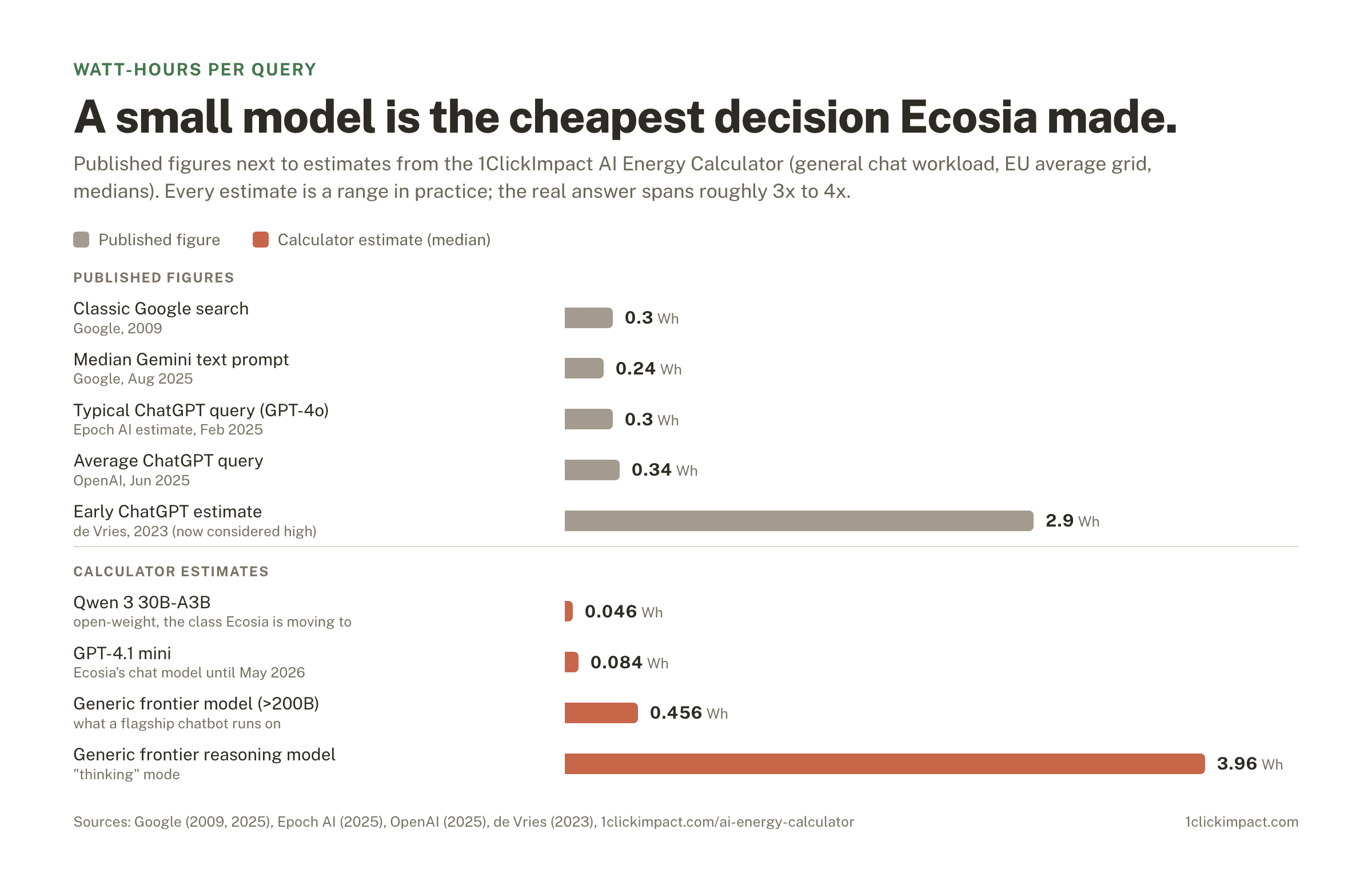
The medians hide a wide band. The Qwen scenario spans 30 to 112 kWh a month between its fifth and ninety-fifth percentiles, and the GPT-4.1 mini run is flagged “estimated” because OpenAI publishes no specifications and the figure is inferred from comparable open models. If you quote these numbers, quote the range.
For scale, the calculator’s own equivalents put the Qwen scenario at about 690 kWh a year, which is roughly 460 days of running a fridge, and 152 kg of CO2e, about 790 km in a petrol car. That is for one million chats a month, and Ecosia has not said how many it serves.
Want the number for a different model, region, or volume?
The calculator is free, needs no sign-up, and shows the range behind every median.
How to turn off Ecosia AI
You have three levels of control, and which one you want depends on whether you object to the summaries, the chat, or the idea.
- 01
Remove only AI Overviews
Open your Ecosia search settings, scroll to Overviews, and untick the box. The same option appears inside the overview itself.
- 02
Leave AI Chat alone and it stays off
AI Chat does not run unless you open it. Ignore the chat entry points and no model is called. The exception is auto-routing, which can send a complex query into the chat on its own. Ecosia lets you decline it the first time it triggers.
- 03
Remove everything with AI-free searching
Open your profile, go to Settings, and select “AI-free searching”. Ecosia added this in July 2026. It disables AI Overviews, removes AI Chat from the navigation and autocomplete, and turns off auto-routing. It launched on desktop first, with mobile promised. Searching with it on still funds trees, because the ads on the results page are what pay for them.

If the names here do not match what you see, check Ecosia’s AI search help page.
Ecosia AI is leaving Mistral
On 6 October 2026, Ecosia founder Christian Kroll told Politico that the company was ending its partnership with Mistral, five months after moving onto it. Reports in heise online and PPC Land relay his reasons.
“We were simply too large a customer for Mistral.”
Kroll said Ecosia was “disappointed with the quality of Mistral” and put its models about a year behind the competition. Overloaded servers caused regular outages, he said. He also objected to the share of nuclear power in the French grid, questioned how European a company funded by Nvidia and Samsung could be, and said the switch roughly halved Ecosia’s costs.
The replacements are open-weight models from Chinese developers, named in the coverage as Alibaba’s Qwen, Zhipu’s GLM, and Moonshot’s Kimi, served through a hosting platform called Melious. Kroll treats political distortions in those models as fixable with post-processing. The AI researcher Rasmus Rothe, quoted by heise, disagrees, arguing that retraining reaches the surface of a model and not its foundation. Mistral’s co-founder Guillaume Lample invited Ecosia to test its newest model instead.
For the energy question, anyone can measure an open-weight model, so a third party could now produce and check the per-query figure Ecosia has never published. Where the models run still decides the grid, though, and Ecosia has said it wants to host models on its own servers on renewable power eventually. If it gets there and publishes the number, the argument about whether its AI is green ends.
If you run AI in your own product
The same question applies to anything you ship with a model behind it, and the answer depends on the same three things: model size, output length, and where it runs. Ecosia got the first two right and is still working on the third.
Measure
Put your model, workload, region, and monthly volume into the AI Energy Calculator. It covers 45 models and reports electricity, water, and carbon as a range, not a single number.
Reduce
Shorter outputs, prompt caching, a smaller model where it is good enough, and a cleaner grid region move the number more than anything you can buy afterwards.

Offset the rest
The AI Energy API returns the same estimate per request, and the Capture Carbon API neutralizes a monthly total in one call, so the offset can run on a schedule instead of a promise.
The two endpoints are documented at docs.1clickimpact.com/ai-energy and docs.1clickimpact.com/capture-carbon.
What does your AI cost the planet?
Pick a model, a workload, and your volume. Get electricity, water, and CO2 as a range you can quote, in seconds, with no sign-up.
Ecosia AI FAQ
Is Ecosia AI free?+
Yes. Ads on the results page pay for it, the same way they pay for the trees. Ecosia is a not-for-profit and says all of its profits go to climate action.
Which model does Ecosia Chat use?+
As of October 2026, Ecosia is moving AI Chat from Mistral Small 4 to open-weight models including Qwen, GLM, and Kimi. AI Overviews have run on Mistral Small 3.2. Ecosia’s help center is the place to check, because the answer has changed three times in three years.
Can I turn off Ecosia AI completely?+
Yes. Open your profile, go to Settings, and choose “AI-free searching”. It removes AI Overviews, the chat entry points, and auto-routing in one step.
Does Ecosia Chat store my conversations?+
By default they stay in your browser’s local storage. If you turn on chat history, Ecosia stores them encrypted on its servers. Uploaded files and generated images are deleted within seven days.
Does Ecosia use my chats to train AI models?+
Ecosia says conversations are private and are not used to train AI models, and that since the May 2026 provider switch, third parties do not store your queries, even temporarily. It still advises against pasting personal, financial, or health information into the chat.
Is Ecosia Chat available in my country?+
Ecosia lists roughly 35 countries for AI Chat, mostly in Europe plus the US, Canada, Australia, New Zealand, and Brazil, and 13 for AI Overviews. Both are still rolling out, so availability can differ by account.
Does Ecosia AI use more energy than a normal Ecosia search?+
Yes. Ecosia says so itself, and the published measurements agree that generating an answer costs more than retrieving ten links. The gap is much smaller than the ten-times figure from 2023 if the model is small, and much larger if it reasons.
Is Ecosia AI greener than ChatGPT?+
Per query, very likely. Ecosia runs small models and skips reasoning, video, and deep research, and in our calculator a small open-weight model lands at roughly a fifth to a tenth of a frontier model’s energy for the same chat. Ecosia has not published its own measurement, so the comparison rests on model size rather than a disclosed figure.
Does searching with AI still plant trees?+
Ecosia says searching funds trees and climate action whether AI is on or off, because the ads on the results page are what pay for them.
Keep reading
Ecosia documents its AI features, countries, and settings in its help center and posts product changes on its blog. The calculator figures in this post come from our own methodology page, which lists the measurements every coefficient is calibrated against. For a different angle on the same problem, the AI carbon footprint guide walks through offsetting what a product’s AI usage emits.