
What plastic neutral means
Plastic neutral means a company funds the collection and recovery of as much plastic waste by weight as it puts into the world over a stated period, usually a year. The plastic recovered is not the same plastic the company sold. It is a funding balance, not a physical one.
No government or standards body defines the term. What it means in any particular case depends entirely on what the company measured, what it funded, and what it can show you. This page sets out the definition, how the weight is counted, how plastic neutral differs from plastic free and plastic negative, and what it costs.
- Every figure sourced and dated
- What it does not mean, stated plainly
- No certification claimed

Same weight. Not the same plastic, and not in the same place.
The definition
An accounting claim about weight over a period, and the three things that have to be true for it to mean anything.
A company estimates the weight of plastic it put on the market over a stated period, then pays for an equivalent weight of plastic waste to be collected and processed somewhere else. If the two weights match, the company describes itself as plastic neutral for that period. Three things therefore have to be true before the words carry information: the period is stated, the footprint was measured rather than guessed, and the collection can be evidenced.
The structure is borrowed from carbon accounting, and the unit of trade is usually a plastic credit — a certificate representing a verified weight of plastic waste collected, or collected and recycled, by a funded project. Private voluntary standards define what a credit has to prove; there is no public register and no legal definition of the term “plastic neutral” itself.
Collection is also not the same thing as recycling, and the gap is wide. The OECD's Global Plastics Outlook (2022) put the share of plastic waste recycled worldwide at about 9%, with roughly 22 million tonnes leaking into the environment in 2019. A pound collected is a pound kept out of a river or a coastline, which is a real outcome and a different outcome from a pound turned back into new material. Honest pages say which one they funded.
What plastic neutral does not mean
- It does not mean the product contains no plasticThat claim is “plastic free”, and it is about materials rather than money.
- It does not mean your plastic was recoveredThe plastic collected is other plastic, usually in another country. Your packaging still goes wherever your customers put it.
- It does not reduce the plastic you useOnly changing design, materials or volume does that. Funding collection runs alongside reduction; it is not a substitute for it.
- It does not make a product environmentally neutralPlastic weight is one impact. Emissions, water, land and chemistry are untouched by a plastic balance.
- It is not a compliance positionNo regulator treats plastic neutrality as satisfying a packaging, waste or extended producer responsibility obligation.
How plastic neutrality is measured
Five steps, in order. Steps one and two decide whether the claim means anything; steps three to five are the easy part.
- 1
Draw the boundary
Decide what counts: primary packaging, secondary and shipping plastic, plastic in the product itself, and operational plastic such as pallet wrap and films. Say which of those you included. What a company leaves out is where most plastic claims quietly fall apart.
- 2
Weigh it, do not count it
The unit is weight, not items. For each SKU, multiply units shipped by the plastic weight per unit from the bill of materials, then add the operational plastic. Grams matter at volume: one gram per order across a million orders is a tonne.
- 3
Fix the period
Neutrality is only ever true for a stated window, normally a financial year. A claim with no period attached cannot be checked, and cannot be repeated next year without doing the work again.
- 4
Fund an equal weight of collection
Buy collection — or collection and recycling — for the same weight, from a project that can evidence it. The weight is what is matched. The material, polymer type and location almost never match, and a careful claim does not pretend otherwise.
- 5
Write the claim with its scope attached
“Plastic neutral” on its own is the kind of unqualified general environmental benefit claim the FTC Green Guides (2012) treat as deceptive without substantiation, and the UK CMA's Green Claims Code (2021) asks the same. Name the period, the weight, the boundary and the project.
The half nobody audits
Collection is the audited side: weights are logged where the plastic is handed in, and standards exist to check them. The footprint is the company's own estimate from its own specifications, and it is rarely audited by anyone. When you read a plastic neutral claim, that is the number to ask about first — including on this site.
Plastic neutral vs plastic free vs plastic negative
Three claims that get used interchangeably and mean different things. Only one of them is about the plastic in your own product.
| What you are comparing | Plastic neutral | Plastic free | Plastic negative |
|---|---|---|---|
| What it claims | Over a stated period, the company funded the recovery of at least as much plastic waste by weight as it put on the market. | The product, packaging or operation contains no plastic at all. | Funded recovery exceeds the plastic put on the market, usually by a stated multiple such as 2×. Also sold as “plastic positive”. |
| What happens to the company's own plastic | Nothing. It stays in circulation and still has to be disposed of somewhere. | It never exists, so there is nothing to dispose of. | Nothing. The multiple changes the budget, not the packaging. |
| What gets measured | Weight of plastic placed on the market, against weight of plastic collected and evidenced. | Material composition of every component, including liners, labels, tapes and films. | The same two weights as plastic neutral, with a multiplier applied to the second. |
| Who defines it | No government or standards body. Private voluntary standards set their own rules; the best known are the Ocean Bound Plastic standards (Zero Plastic Oceans, 2020) and Verra's Plastic Waste Reduction Standard (2021). | No legal definition either, though the words are read literally, so the bar is a matter of fact rather than methodology. | Whoever is selling the credits. |
| The hardest part | Measuring your own plastic footprint honestly, including what you excluded. | Finding materials that match plastic's barrier properties, weight and cost. | Nothing new. It is plastic neutral at a higher price. |
| Where the claim breaks | It does not reduce plastic use, and the plastic recovered is not the company's plastic or in the company's market. | Few supply chains are plastic free end to end, so the claim often quietly covers one component. | A multiple of a badly measured baseline is still badly measured. |
None of the three terms has a legal definition. Standards named above are voluntary and privately written; see the sources at the foot of this page.
The short version: plastic free is a claim about materials, plastic neutral and plastic negative are claims about money. A plastic free product has solved the problem for itself. A plastic neutral one has paid for someone else's plastic to be collected, which is useful and is not the same achievement. Companies that do both describe them separately, and that is the pattern worth copying.
What ocean-bound plastic means
The material most plastic neutrality is funded with, the 50-kilometre definition behind it, and who writes the rules.
Ocean-bound plastic is abandoned plastic waste lying within about 50 kilometres of a coastline, in places where waste collection is inadequate or absent, so it is likely to reach the sea. It has not been in the ocean. That is the whole point of the category: it is intercepted before it gets there, which is cheaper, safer and far more effective than retrieving fragments from open water.
The 50-kilometre band is not arbitrary. It comes from Jambeck et al., published in Science in 2015, which modelled plastic entering the ocean from the population living within 50 km of a coastline and put the 2010 figure at 4.8 to 12.7 million tonnes. Meijer et al., in Science Advances in 2021, narrowed the geography further: more than a thousand rivers carry about 80% of riverine plastic emissions, most of them where collection infrastructure is thin.
Which is why collection is funded where it is. It is also why “ocean plastic” and “ocean-bound plastic” are different claims, and why a careful page uses the second one.
Who certifies it, and what we do and do not claim
Writes the definition of ocean-bound plastic used in certification, plus separate standards for its collection, recycling and neutrality claims. Audits against them are carried out by the certification body Control Union.
Read the standardA separate voluntary standard that issues plastic waste collection and recycling credits against audited project methodologies, in the same shape as its carbon programme.
Read the standardOur own position
1ClickImpact is not a certification body and does not issue plastic neutral certifications. We fund collection through Plastic Bank, across 5 programmes in 5 countries, including the Indonesia and Philippines programmes, and we report the weight collected with location data, photos and a certificate per cleanup. If you want a certified claim, the two standards above are where to start, and the question to ask any supplier is which standard they are audited against and by whom.
See how collection is evidenced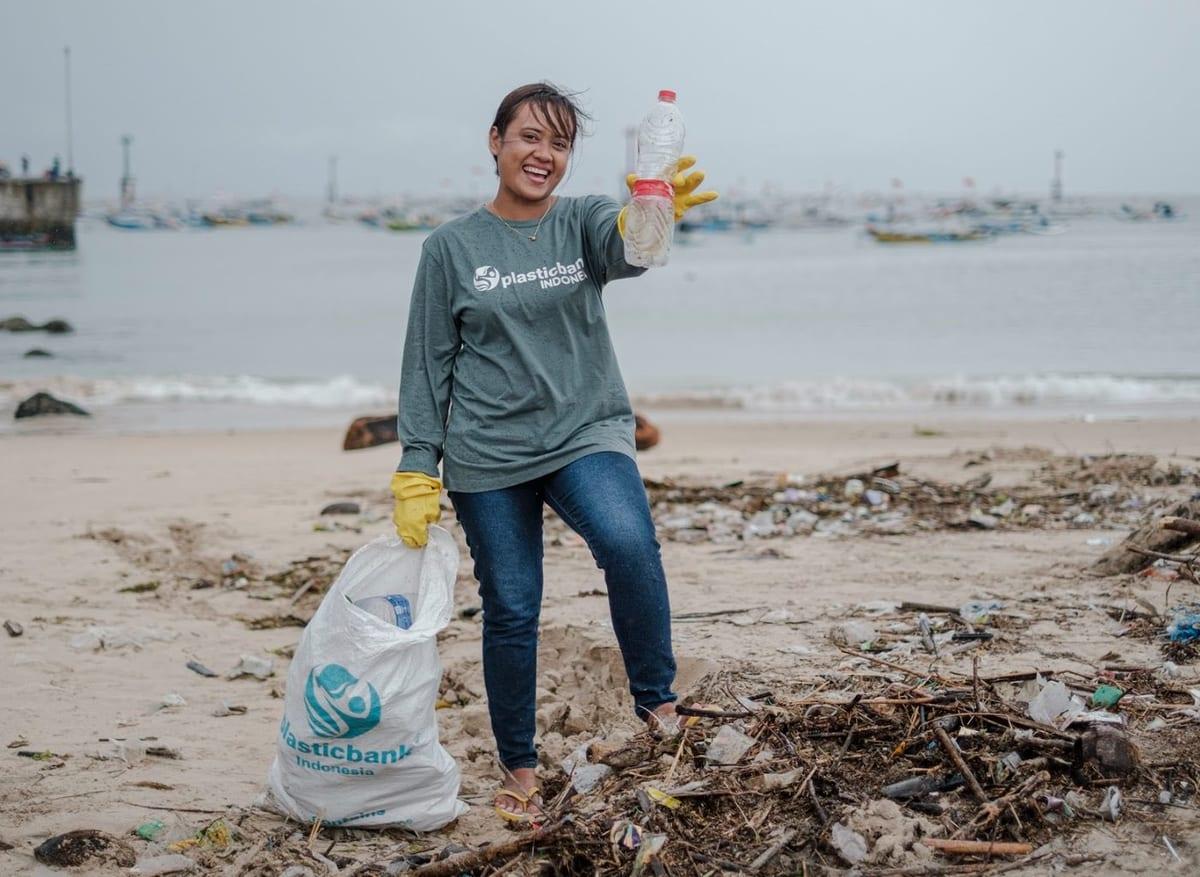

How a brand becomes plastic neutral
Five steps in the order that makes the claim defensible, and the wording that decides whether anyone believes it.
- 1
Reduce first, balance what is left
Redesign, lighten, switch material or move to refills before you buy a single pound of collection. The plastic you never ship costs nothing to collect and does not need a claim. Doing this in the other order is what gives the whole category its reputation.
- 2
Measure what remains
Take the plastic weight per unit from each SKU's bill of materials, multiply by units shipped over twelve months, and add shipping and operational plastic. Write down what you excluded — that list is part of the claim, not a footnote to it.
- 3
Choose what you fund, and where
Collection alone and collection-plus-recycling are different products at different prices. So are ocean-bound plastic and general municipal waste. Pick deliberately, and name the project rather than the category. Ocean-bound collection through Plastic Bank is what this site funds.
- 4
Wire it to something that actually happens
A yearly purchase is a line item that gets cut. A trigger is not. Collect per order with the Shopify app, per signup or per invoice through the API, or per event through Zapier, so the funded weight tracks the plastic weight automatically.
- 5
Publish the numbers, not the badge
Period, weight, boundary, project, and a link to the evidence. A claim people can check is worth more than a logo, and it is the only version that survives a procurement questionnaire or a journalist.
What a defensible version reads like
A worked example about a made-up brand. Neither 1ClickImpact nor any customer is making the claim below.
- “In the 12 months to 31 December 2025 Example Co. shipped an estimated 1,250 lb of plastic in packaging and products, excluding plastic in inbound freight.”
- “Example Co. funded the collection of 1,250 lb of ocean-bound plastic through Plastic Bank in Indonesia and the Philippines. Collection weights, locations and photos are published on its impact page.”
- “This does not reduce the plastic Example Co. uses. Its packaging redesign is cutting that separately, and it reports it separately.”
Longer than a badge, and the only version that answers the next question.
Wording to avoid, and why
- “Plastic neutral since 2024.”No period, no weight, no boundary. Nothing to check.
- “100% plastic neutral product.”Attaches a company-wide balance to a single product. That is the kind of overstated, unqualified claim the FTC Green Guides (2012) warn against.
- “Every order removes plastic from the ocean.”Ocean-bound plastic is intercepted before it reaches the ocean. Say that instead; it is the stronger fact anyway.
- “Plastic neutral, so our packaging is sustainable.”A weight balance says nothing about emissions, recyclability or chemistry.
What it costs
The rate is the easy part. The bill is decided by how much plastic you ship, which is why the reduction step comes first.
$0.60per lb
Ocean-bound plastic collection through Plastic Bank costs $0.60 a pound on this site — about 23 plastic bottles — with no minimum and no annual contract. You pay for the weight you fund, in the month you fund it.
That buys collection and processing, with the weight logged at the collection point, location data, photos and a certificate. It does not buy a certification, and it does not buy a claim: the claim is yours to make, and yours to word carefully.
What one order costs to balance
Packaging weight is the whole equation. Every ounce you design out is an ounce you never pay to collect.
- 2 oz7.5¢
- 4 oz15.0¢
- 6 oz22.5¢
- 8 oz30.0¢
Four worked examples, with the assumption shown
| Example | Assumption | Plastic weight | Bottle equivalent | Cost at $0.60/lb |
|---|---|---|---|---|
| One parcel | 2 oz of packaging plastic in a single order | 0.125 lb | 3 | 7.5¢ |
| A small store | 10,000 orders a year at 2 oz each | 1,250 lb | 28,750 | $750 |
| A growing brand | 50,000 orders a year at 4 oz each | 12,500 lb | 287,500 | $7,500 |
| A product line | 250,000 units a year at 12 oz each | 187,500 lb | 4,312,500 | $112,500 |
Arithmetic on the stated assumptions, not case studies. Packaging weights vary enormously between products, and most teams find their real figure is heavier than they guessed; measure yours before budgeting from a row here.
Verification and evidence
What can be shown, what cannot, and the three questions worth asking any supplier — this one included.
Weight logged where the plastic is handed in
Collectors are paid by weight, so the weight is recorded at the point of collection rather than estimated afterwards. That record is the unit everything else is built on.
Location data and photographs
Which programme, which community, and photographs from the collection itself. A weight with no place attached is not evidence of anything.
A certificate for every cleanup
One certificate per funded cleanup, in your branding, with the weight and the programme on it — shareable with customers and usable in reporting.
A running total you did not write
Your impact dashboard and your public impact page add up from the same collection records, so the number on your website and the number in the ledger cannot drift apart.
What this evidence does not prove
- It does not prove your plastic was recovered. Different plastic, usually a different continent.
- It does not prove the plastic was recycled. Collection and recycling are separate claims with separate standards; say which one you funded.
- It is not a lifecycle assessment. Weight says nothing about the emissions, water or chemistry of your packaging.
- It is not an audit of your footprint. The weight you set out to balance is still your own estimate.
Three questions for any supplier
- 01Which standard are you audited against, and by which certification body?
- 02What weight was collected, in which programme, over which period?
- 03Does the price cover collection only, or collection and recycling?
Where claims law is heading
Nothing in law defines plastic neutrality, but plenty of law governs how you may talk about it. The US Federal Trade Commission's Green Guides (2012) treat an unqualified general environmental benefit claim as deceptive unless it can be substantiated, and want the qualifying detail next to the claim rather than three clicks away. The UK Competition and Markets Authority's Green Claims Code (2021) says much the same in different words.
The clearest signal is European. Directive (EU) 2024/825 bans claiming that a product has a neutral, reduced or positive environmental impact on the basis of offsetting, with member states applying it from 27 September 2026. It is written for greenhouse gas emissions and does not name plastic — so it does not, today, prohibit a plastic neutrality claim. It does show which way the wind blows for any claim whose mechanism is paying for something elsewhere. Treat “plastic neutral” as a description of what you funded, never as a compliance position, and the change will not catch you out.
Sources
Every scientific, definitional and regulatory statement on this page comes from one of these, named with its year. Prices and programme counts come from this site's own published rates and project data.
- 01Jambeck et al., “Plastic waste inputs from land into the ocean”, Science, 2015Estimated 4.8–12.7 million tonnes of plastic entered the ocean in 2010, modelled from the population living within 50 km of a coastline. The 50 km band used by ocean-bound plastic standards traces back to this paper.
- 02OECD, Global Plastics Outlook, 2022Reported that about 9% of plastic waste is recycled worldwide, and that roughly 22 million tonnes of plastic leaked into the environment in 2019.
- 03Meijer et al., “More than 1000 rivers account for 80% of global riverine plastic emissions into the ocean”, Science Advances, 2021Found that plastic reaching the sea by river is concentrated in a relatively small number of waterways, most of them in countries with limited waste collection.
- 04Zero Plastic Oceans, Ocean Bound Plastic Certification programme, established 2020Writes the standards that define ocean-bound plastic and its collection, recycling and neutrality claims. Audits against them are carried out by the certification body Control Union.
- 05Verra, Plastic Waste Reduction Standard, 2021A separate voluntary standard that issues plastic waste collection and recycling credits against audited project methodologies.
- 06US Federal Trade Commission, Green Guides, 16 CFR Part 260, 2012Treats unqualified general environmental benefit claims as deceptive unless the advertiser can substantiate them, and asks for qualifying language close to the claim.
- 07Directive (EU) 2024/825 on empowering consumers for the green transition, 2024Bans claiming that a product has a neutral, reduced or positive environmental impact on the basis of offsetting greenhouse gas emissions. It is written for emissions rather than plastic, and member states apply it from 27 September 2026.
- 08UK Competition and Markets Authority, Green Claims Code, 2021Sets out that environmental claims must be truthful, unambiguous, not omit material information, and be capable of substantiation.
Frequently asked questions
The questions people ask about plastic neutrality, answered without the marketing.
Plastic neutral means a company funds the collection and recovery of as much plastic waste by weight as it puts into the world over a stated period, usually a year. The plastic recovered is not the same plastic the company sold. It is a funding balance, not a physical one, and no government or standards body defines the term.
No, and they are close to opposites in method. Plastic free means a product or operation contains no plastic at all, which is a claim about materials. Plastic neutral accepts that the plastic exists and pays for an equivalent weight to be collected elsewhere. A plastic neutral company still ships plastic.
Ocean-bound plastic is abandoned plastic waste sitting within about 50 kilometres of a coastline in places where waste collection is inadequate or absent, so it is likely to reach the sea. The 50 km band comes from Jambeck et al., Science, 2015, which modelled ocean plastic input from coastal populations. The definition used in certification is written by Zero Plastic Oceans, whose Ocean Bound Plastic programme dates from 2020.
Both are possible, and the difference is evidence. Funding collection where waste management is missing intercepts plastic that would otherwise reach the sea, and Meijer et al., Science Advances, 2021 found those emissions concentrate in a small number of rivers. It becomes greenwashing when it is used to imply a product is plastic free, to claim compliance, or when nobody can say how much was collected, where, or who checked.
Verification has two halves, and only one of them is usually audited. The collection side produces weights logged at the collection point, location data, photos and certificates. The footprint side — how much plastic the company actually put on the market — is normally the company's own estimate from its bills of materials, and is rarely audited by anyone. Ask any provider, including us, which standard they are audited against and by whom. See how ocean plastic collection is evidenced.
On 1ClickImpact, ocean-bound plastic collection costs $0.60 per pound, which is about 23 plastic bottles, with no minimum. The total depends entirely on your own plastic weight: a store shipping 10,000 orders a year with two ounces of plastic per order is funding 1,250 lb, or $750 a year. See pricing.
The accounting is similar and the physics is not. Carbon dioxide mixes globally, so a tonne removed anywhere offsets a tonne emitted anywhere. Plastic does not mix: it stays where it is dropped, breaks into fragments and harms a specific place. Collecting a pound in Indonesia does not remove the pound of packaging in a landfill in Ohio. That is why plastic neutrality is better read as funding cleanup than as cancelling your own plastic out.
There is no government or international standard that defines plastic neutrality. There are private voluntary standards, the best known being the Ocean Bound Plastic standards from Zero Plastic Oceans, audited by Control Union, and Verra's Plastic Waste Reduction Standard from 2021. 1ClickImpact is not a certification body and does not issue plastic neutral certifications: we fund collection through Plastic Bank and report the weight collected, with photos and location data.

Fund ocean-bound plastic collection, and say exactly what you funded
Collection through Plastic Bank from $0.60 a pound, with the weight, the place and the photographs behind every pound.