
Coral Planting: How Reef Restoration Actually Works
Coral planting attaches living coral fragments to damaged reef so it grows back. How fragmenting and outplanting work, growth rates, survival data, costs.
Coral planting is one of the few conservation methods where you can hold the result in your hand. It is also one of the easiest to do badly. This is how the work is really done, what the published survival data says, and what it costs.
From $2.20 a fragment. Fifteen fragments rebuild one reef structure.

Coral planting is the practice of attaching small pieces of living coral to a degraded reef so it grows back. Divers collect or nursery-grow fragments, fix them to stabilised reef surface, then return to monitor them. It is the most widely used method in active coral reef restoration.
The short version
- Coral planting means attaching living coral fragments to degraded reef, by hand, underwater. The fragments are either rescued after storms break them loose or grown in a nursery first.
- Branching corals put on 10 cm or more of length a year; massive, boulder-forming corals manage 0.3 to 2 cm (NOAA National Ocean Service). The coral form decides whether you are waiting one year or thirty.
- Median reported survival of restored coral is 64.5% (Bayraktarov et al. 2016). The largest review of the field found the median project ran about 12 months, so survival past the first year or two is still thinly evidenced (Bostrom-Einarsson et al. 2020).
- Planting only works where the reason the reef died has been dealt with. On rubble, the ground has to be held still first or nothing stays attached.
- Through 1ClickImpact, one coral fragment costs $2.20, and 15 fragments rebuild one modular reef structure of roughly 2,160 cm².
Reefs occupy a small fraction of the ocean floor and shelter roughly a quarter of all marine species, according to NOAA's Coral Reef Conservation Program. The Global Coral Reef Monitoring Network estimated in 2021 that the world lost about 14% of its living coral between 2009 and 2018, and in April 2025 the International Coral Reef Initiative reported that roughly 84% of the world's reef area had been hit by bleaching-level heat stress during the fourth global bleaching event.
Against numbers like those, planting coral by hand sounds absurd, and at a global scale it is. Restoration is not a climate solution and nobody serious claims it is. What it does is rebuild structure, cover and diversity at specific sites where the local reason the reef died has been dealt with, so the reef has something to recover from when conditions allow. That is a narrow claim, and it is the honest one.

What coral planting is
A coral colony is not a plant or a rock. It is a colony of animals, tiny polyps that build a shared calcium carbonate skeleton. That skeleton is why planting works at all: break a branching coral and the pieces can carry on growing, because each fragment already contains living polyps and their symbiotic algae. Coral planting exploits that. It takes a fragment, gives it a stable surface, and lets it do what it would have done anyway if the current had not dropped it on sand.
The vocabulary gets used loosely, so it is worth separating:
Coral planting — the general act of fixing living coral onto reef. Also called outplanting when the fragment comes from a nursery.
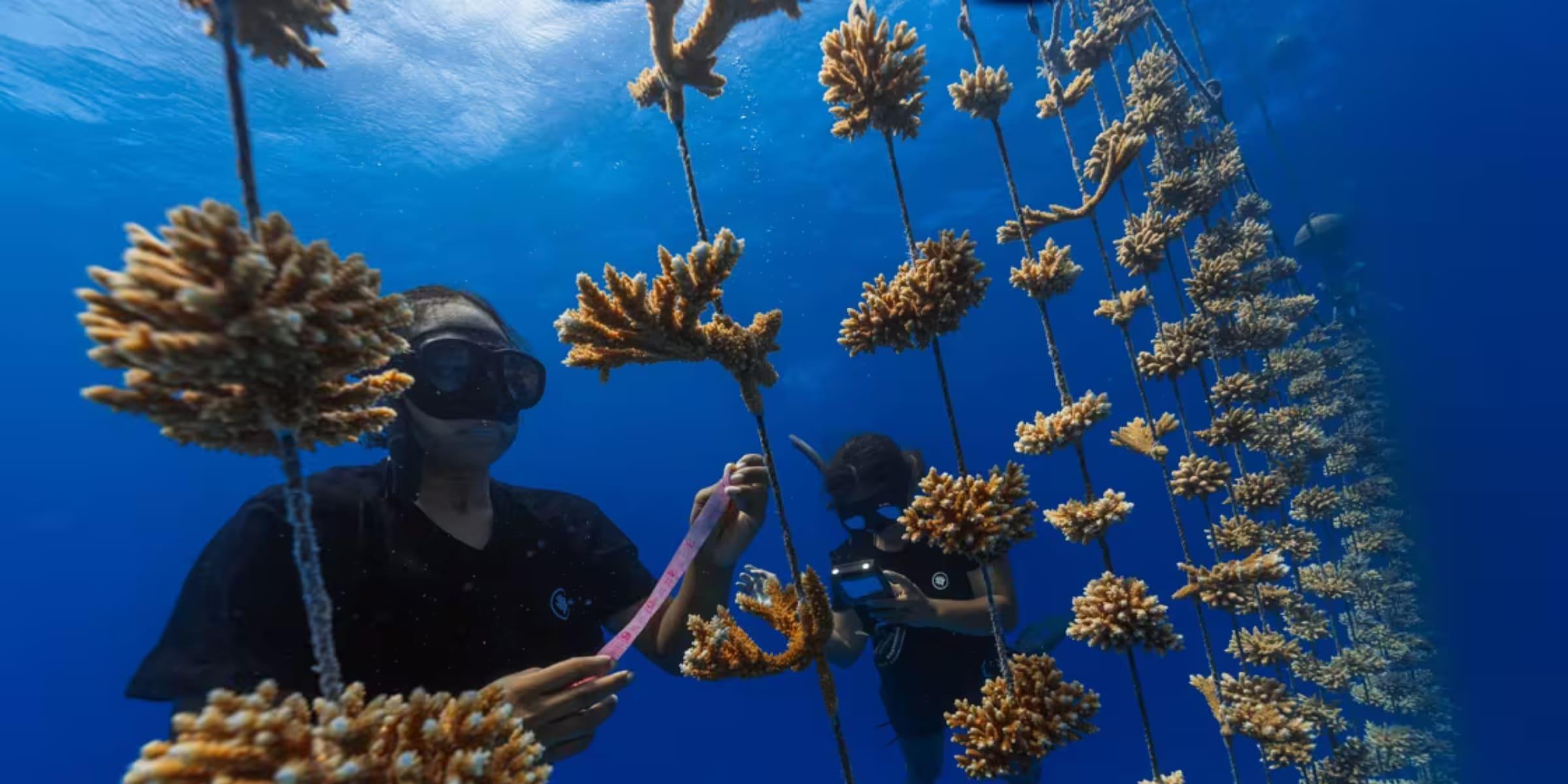
Coral gardening — planting with a nursery stage in the middle. Fragments are grown on ropes, tables or trees for roughly a year first.
Direct transplantation — planting without a nursery. Fragments go from the seabed or a donor colony straight onto the restoration site.
Coral reef restoration — the whole discipline, which also covers rubble stabilisation, larval seeding, predator removal and protection measures that involve no planting at all.
What coral planting cannot do
Planting does not cool water, cut emissions or stop a bleaching event. Put fragments on a reef that is still being blast-fished, buried in run-off or stripped of grazing fish and they will die on schedule. Every credible project in this field treats planting as the last step after the local threat has been addressed, not as a substitute for addressing it.
How corals are fragmented and outplanted
Six stages, in order. The glamorous bit is stage four and it is the one that matters least.
- 01
Choose a site that can actually hold coral
Site selection decides most of the outcome before anyone gets in the water. Teams survey depth, current, sediment load, remaining live coral cover and the condition of the substrate. Reefs that are still being blast-fished, buried in sediment or stripped of grazing fish will not keep planted coral alive, however good the planting is.
- 02
Source the fragments
There are three routes. Rescue fragments that storms and anchors have already knocked loose, which is what the Nusa Penida project does. Cut small pieces from resilient wild colonies and grow them in a nursery for roughly a year, which is Coral Gardeners' method. Or micro-fragment a single colony into many pieces that later fuse back together. Only the first two are common.
- 03
Prepare the surface
Coral needs hard, still ground. On dead but intact reef that means scraping algae and sediment off a patch of rock. On a rubble field it means stabilising the rubble first with mesh, cement, rock piles or modular steel structures, because loose rubble grinds settling larvae to death every time the current turns.
- 04
Attach the coral
Fragments are fixed with marine epoxy, cement, nails and wire, cable ties or purpose-made plugs. The attachment has to hold for the months it takes the coral to cement its own skeleton to the substrate. Materials matter more than they sound: the Nusa Penida team trialled zip ties, hemp rope, cotton twine, stainless steel and aluminium wire, and switched to aluminium after the trial.
- 05
Come back, repeatedly
Planted coral is tended, not installed. Dive teams return to brush off macro-algae, remove coral-eating Drupella snails and encroaching sponges, re-secure fragments that have worked loose, and replace losses. A project without a maintenance schedule is a set of structures on a seabed.
- 06
Measure what happened
Credible projects publish method and outcome: fragment-level survival logs, photo transects on fixed quadrats, fish counts, benthic diversity surveys, and increasingly 3D photogrammetry so a patch can be compared year to year rather than remembered. The number that matters most is natural recruitment, baby corals nobody planted settling by themselves.

The six methods, and when each one is the right call
No method is best in general. Each one answers a different reason the reef failed, which is why a project that only owns one technique tends to use it everywhere.
| Method | What it does | Suited to | Main limitation |
|---|---|---|---|
| Direct transplantation | Loose fragments, broken off by storms or boats, are rescued and reattached to hard reef the same day. | Reefs with a healthy neighbour producing a steady supply of fragments of opportunity. | Supply is weather-dependent, and genotypes are whatever broke, not whatever is most heat-tolerant. |
| Coral gardening | Small pieces are cut from resilient wild colonies, grown on nursery ropes, tables or trees for about a year, then outplanted. | Large programmes that need volume, species choice and selection for bleaching survivors. | Needs a nursery, boats and a year of lead time before the first coral reaches the reef. |
| Micro-fragmentation | A colony is cut into very small pieces that grow quickly and fuse back into one large colony when planted together. | Slow-growing massive and brain corals, which take decades to reach size from a single fragment. | Requires precise cutting, often land-based tanks, and produces a single genotype per patch. |
| Substrate stabilisation | Rubble is pinned down with mesh, cement, rock piles or modular steel structures, then planted. | Blast-damaged or cyclone-flattened reef where nothing can stay attached to moving rubble. | Material and installation cost per square metre is the highest of any method listed here. |
| Larval propagation | Spawn is collected during mass spawning, reared, and the settled larvae are seeded onto the reef. | Rebuilding genetic diversity, which fragmenting cannot do because every fragment is a clone. | Tied to a few spawning nights a year, and survival from larva to visible colony is very low. |
| Mineral accretion structures | A low electrical current on a steel frame precipitates limestone, giving coral a chemically friendly surface. | Sites with power access and a research team attached. | Needs a continuous power supply, and independent evidence for the added benefit is thin. |
Method categories follow the taxonomy in Bostrom-Einarsson et al. (2020), a systematic review of 362 coral restoration case studies.
How long a planted coral takes to grow
The answer depends almost entirely on the coral's shape. NOAA's National Ocean Service puts branching corals at 10 cm or more of linear growth a year and massive, boulder-forming corals at 0.3 to 2 cm. That is a thirty-fold difference, and it is the single most useful fact in this whole article.
| Coral form | Example genera | Reported linear growth | What that means in the water |
|---|---|---|---|
| Branching and plating | Acropora, Pocillopora | 10 cm or more per year | A 5 cm fragment can be a hand-sized colony inside two years. This is why restoration projects lean on these species. |
| Massive and boulder | Porites, Diploastrea | 0.3 to 2 cm per year | Decades to reach the size of a football. Micro-fragmenting is the usual workaround. |
Growth rates: NOAA National Ocean Service. Rates vary with light, temperature, water flow and nutrients, so treat these as ranges rather than a schedule.
A branching fragment, year by year
What 10 cm of annual growth looks like for a 5 cm Acropora fragment. This is arithmetic on NOAA's published range, not a forecast for any individual coral: a heatwave, a snail or a bad attachment can end it in month three.
- Planted
- 5 cm fragment
- Year 1
- about 15 cm
- Year 3
- about 35 cm
- Year 5
- about 55 cm
A coral reaching hand size is not the same as a reef recovering. Reef recovery is measured as a carbonate budget: whether the structure is accreting limestone faster than erosion and grazing remove it. On that measure there is now at least one encouraging published result. Lange and colleagues reported in Current Biology in 2024 that at the restored Pulau Bontosua site in South Sulawesi, Indonesia, carbonate budgets had recovered to levels comparable with healthy reference reefs within four years of planting.
Four years is fast, and that site had unusually favourable conditions and a well-funded method behind it. Treat it as an upper bound of what good restoration can do, not a typical timeline.
Survival rates and what affects them
Two papers carry most of the weight here. Bayraktarov and colleagues, writing in Ecological Applications in 2016, reviewed the costs and outcomes of marine coastal restoration and put median survival of restored coral at 64.5%, with a median project cost of around US$400,000 per hectare in 2010 dollars. Four years later, Bostrom-Einarsson and colleagues published a systematic review of 362 coral restoration case studies in PLOS ONE.
median reported survival of restored coral
restoration case studies reviewed in 2020
median project duration in that review
The caveat that matters more than the number
In the 2020 review the median project ran for about 12 months and most reported less than 18 months of monitoring. A 65% survival figure measured at one year says very little about year five, which is roughly when a planted branching coral would reach reproductive size. Anyone quoting a survival percentage without a time period attached is quoting half a statistic. That includes vendors.
The four things that decide the outcome
Heat stress
Bleaching-level heat stress can kill a whole cohort of planted fragments before any of them cements itself, and it is the one factor on this list the planting team has no control over — which is why site selection for thermal refuge matters so much.
Grazers and predators
Parrotfish and urchins keep algae off young coral, so reefs stripped of grazers plant badly. Drupella snails and crown-of-thorns starfish work the other way and have to be removed by hand.
Fragment size and attachment
Bigger fragments survive better than small ones, and a fragment that works loose before it cements itself is lost. This is the part a project can fix with better materials and tighter method.
Maintenance frequency
Algae, sediment and sponges smother young coral within weeks. Projects that dive their sites monthly report different outcomes from projects that come back annually.
How to tell a serious project from a photogenic one
- It publishes survival over time, not a planting count.
- It names its monitoring method: transects, quadrats, fish counts, photogrammetry.
- It publishes things that did not work and what it changed as a result.
- It has a maintenance schedule and sticks to it.
- It works inside a protected area or with enforcement in place, so the original threat is actually gone.
- It is run or staffed by people who live there.
Who does coral restoration
A short, honest list. Two of these are our own partners and are marked as such; the rest are included because they are the organisations whose published method and results are worth reading, not because they are connected to us.
Mossy Earth
Our partnerNusa Penida Marine Protected Area, Indonesia
Rewilding organisation running Wilder Reefs, which stabilises blast-damaged rubble with modular steel hexagons and transplants naturally dislodged fragments onto them. Publishes monthly updates, survey results and failed trials. 1ClickImpact's coral restoration partner.
Read their workCoral Gardeners
Our partnerMo'orea, French Polynesia and Malolo Island, Fiji
Started in 2017 by local surfers, fishers and free-divers in Mo'orea. Grows climate-resilient fragments in lagoon nurseries for about a year before outplanting, propagates more than 50 species, and monitors growth through its ReefOS platform and Reef App. 1ClickImpact's second coral partner.
Read their workCoral Restoration Foundation
Florida Keys and St. Croix, United States
Runs large offshore nurseries for the threatened Caribbean staghorn and elkhorn corals, and outplants them onto Florida's reef tract. One of the longest-running coral gardening programmes anywhere.
Read their workReef Renewal Foundation International
Bonaire, Curacao and a wider network
A network of nursery and outplanting programmes, strongest in the Dutch Caribbean, working with local dive operators and using sexually propagated corals to widen the genetic pool rather than replanting clones.
Read their workSECORE International
Caribbean and Pacific, with research partners
Specialises in larval propagation: collecting coral spawn, rearing larvae and seeding them onto reefs with self-settling substrates. The main route to restoring genetic diversity rather than cloning survivors.
Read their workMars Sustainable Solutions
South Sulawesi, Indonesia and other sites
Developed the Reef Star, the hexagonal sand-coated steel frame used by the MARRS method. A 2024 study of its Pulau Bontosua site reported restored reef carbonate budgets matching healthy reference reefs within four years.
Read their workNOAA Mission: Iconic Reefs
Florida Keys National Marine Sanctuary
A US federal programme restoring seven reef sites in the Florida Keys, notable for publishing a staged, decades-long plan with target coral cover rather than a planting count.
Read their workWilder Reefs, Nusa Penida
Generalities about coral planting are easy. Here is one real project in detail, because the detail is where restoration either holds up or does not. Nusa Penida sits southeast of Bali inside the Coral Triangle, the most biodiverse stretch of ocean on the planet. 1ClickImpact funds this site through Mossy Earth's Wilder Reefs programme, run by a local team with a licence from Indonesia's marine ministry.
The problem is the ground, not the coral
Decades of dynamite fishing, anchor strikes and overfishing left craters of loose rubble inside the marine protected area. Coral larvae drift in and need something solid to cement themselves to. On rubble, every current shifts the pieces and grinds the settlers off, which is why the site could take centuries to consolidate unaided.
Steel hexagons, resin and sand
Modular steel frames roughly 50 cm across are coated in resin and sand, then staked down over the rubble. The coating resists corrosion and gives polyps a rough surface to grip. Once the ground stops moving, settlement becomes possible again.
Nothing healthy is cut
Divers collect fragments that storms and currents have already broken off the healthy reef next door, across a wide mix of species, so the new patch colonises the way a wild reef would rather than as a monoculture. Pieces of the same parent colony go on one structure so they fuse as they grow.
Monthly dives, published failures
The team dives the sites every month to brush off macro-algae, remove Drupella snails and coral-killing sponges, and read coral health from calcium carbonate deposition. When the attachment trial found aluminium wire beat hemp rope and cotton twine, they published the result and changed the method.
The reef has started reseeding itself
By January 2026 the team counted more than 120 wild coral recruits in Area 1 and 37 in Area 2. Nobody planted those. Resident damselfish now live on the frames, and sergeant majors have started laying eggs on them.
A site chosen for its odds
The area sits in a localised potential thermal refugium, where high subsurface temperature variability and pockets of local cooling may reduce heat stress. Restoring coral that has a better chance of surviving the next marine heatwave is a better bet than restoring reef that is likely to cook.
The project in numbers
reef structures on the seabed
coral fragments transplanted
of rubble field stabilised
wild coral recruits in Area 1
The headline number is not the structure count. It is the wild recruits: baby corals that drifted in, found stable ground and settled on their own. When a restored patch starts recruiting by itself, it has stopped being a garden and started being a reef again.
The full story of the partnership

Funding coral restoration as a business
Most businesses that want to back reef restoration run into the same wall: the projects worth funding are small field teams, and sponsoring one means a deck, a contract and a minimum commitment. 1ClickImpact exists to remove that step. Coral is a first-class impact type, billed per fragment, with no platform fee and no minimum.
The fragment is the billable unit because it is the smallest thing a diver physically attaches. One fragment covers roughly 144 cm² of reef as it grows. If you want to adopt a coral reef rather than fund individual fragments, 15 fragments is one whole structure, and the same purchase can be sent to someone else as a gift.
curl --location 'https://api.1clickimpact.com/v1/restore_coral' \
--header 'Content-Type: application/json' \
--header 'x-api-key: YOUR_API_KEY' \
--data '{
    "amount": 15,
    "customer_email": "maya@example.com",
    "customer_name": "Maya"
}'
That request funds fifteen fragments, one full reef structure, and credits it to Maya. She gets her own certificate and a live tracking page. Drop customer_email if the impact belongs to your company rather than a customer.
Restore Coral API
A single REST endpoint, free to call. You pay per fragment, never for API access, and the sandbox is free too.
Read the API docsShopify and Zapier
Restore coral per order, per product, or on any Zapier trigger you already use. No code, and the Shopify app is always free.
See integrationsCertificates and tracking
Every fragment is attributable. Customers get certificates, you get verified totals you can pull back through the API.
Coral for businessTriggers that suit coral particularly well
Dive shops, surf and swim brands. One fragment per order is under three dollars and lines up with what your customers already care about.
Travel and hospitality. Fund a full reef structure per booking, in the region your guests are flying to.
SaaS and subscription products. Tie fragments to a milestone: annual upgrades, referrals, or a yearly team commitment fired from one cron job.
Brands already funding ocean cleanup. Adding reef restoration moves the story from removing plastic to rebuilding habitat.
Put your first corals back on the reef
Start with five fragments, then scale to a full structure whenever you are ready. Every fragment goes on a real frame in protected water, planted by the teams on this page.
Frequently asked questions
What is coral planting?
Coral planting is attaching small pieces of living coral to a degraded reef so it grows back. Divers either rescue fragments that storms have broken loose or grow fragments in an underwater nursery, fix them to cleaned or stabilised reef surface with epoxy, cement or wire, and return regularly to maintain and monitor them. It is the most widely used form of active coral reef restoration.
How is coral planted underwater?
On scuba or snorkel, by hand. The team clears algae and sediment from a patch of hard substrate, or stabilises loose rubble first, then fixes each fragment in place with marine epoxy, cement, nails and wire, cable ties or purpose-made plugs. The attachment only has to hold until the coral cements its own skeleton to the surface, which takes a few months.
How long does coral take to grow?
It depends entirely on the coral's shape. Branching corals such as Acropora and Pocillopora add 10 cm or more of length a year, so a 5 cm fragment can be a hand-sized colony in about two years. Massive boulder corals such as Porites manage 0.3 to 2 cm a year and take decades to reach the same size. Growth rates are from NOAA National Ocean Service and vary with light, temperature and water flow.
What percentage of planted corals survive?
The most cited global figure is a median of 64.5% survival, from Bayraktarov et al. (2016), across the restoration projects they reviewed. The important caveat comes from Bostrom-Einarsson et al. (2020): across 362 case studies the median project ran for about 12 months, and most reported less than 18 months of monitoring, so there is still very little published evidence about survival beyond the first couple of years.
Is coral planting the same as coral gardening?
Coral gardening is one kind of coral planting. It means growing fragments in an underwater nursery for roughly a year before outplanting them. Planting fragments straight onto the reef without a nursery stage is called direct transplantation. Both are coral planting, and both sit under the wider term coral reef restoration.
Does coral planting work if the ocean keeps warming?
Planting does not stop ocean warming and no credible project claims it does. What it can do is rebuild structure, coral cover and genetic diversity at sites where local pressures such as destructive fishing have been brought under control, which improves the reef's chance of resisting and recovering from heat stress. Restoration, cutting emissions and reducing local pressure all have to happen together.
How much does it cost to plant coral?
Through 1ClickImpact a single coral fragment costs $2.20, and 15 fragments rebuild one modular reef structure of roughly 2,160 cm², so a full structure is $33. For context on whole-reef costs, Bayraktarov et al. (2016) reported a median of around US$400,000 per hectare across the coral restoration projects they reviewed, in 2010 dollars.
Can I adopt a coral reef without diving?
Yes. Funding named fragments on a real reef is what most adopt-a-coral-reef programmes actually are, and it is how 1ClickImpact works: you fund fragments, the restoration team plants them, and you get a certificate and a tracking page for the project they went into. You can also send the same restoration to someone else as a gift.
Where does 1ClickImpact's coral restoration happen?
In protected waters at three sites: with Mossy Earth's Wilder Reefs project inside the Nusa Penida Marine Protected Area in Indonesia, and with Coral Gardeners in Mo'orea, French Polynesia and on Malolo Island in Fiji.
Can a business plant coral automatically?
Yes. One POST to /v1/restore_coral with an amount funds that many fragments, and you can pass a customer email so the customer gets their own certificate. If you would rather not write code, the Shopify app and the Zapier integration fire the same action per order, per product or on any trigger you already use.
Sources
Every figure in this article traces to one of these. Where we could not source a number, we left it out rather than rounding a guess.
- 1
Bayraktarov, E., Saunders, M. I., Abdullah, S., et al. (2016). The cost and feasibility of marine coastal restoration. Ecological Applications 26(4).
Used for: Median reported survival of restored coral, and median restoration cost per hectare.
- 2
Bostrom-Einarsson, L., Babcock, R. C., Bayraktarov, E., et al. (2020). Coral restoration: a systematic review of current methods, successes, failures and future directions. PLOS ONE 15(1).
Used for: The method taxonomy used in the comparison table, the 362 case studies, and the monitoring-duration gap.
- 3
NOAA National Ocean Service. How fast do coral reefs grow?
Used for: Linear growth rates for branching and massive corals.
- 4
NOAA Coral Reef Conservation Program.
Used for: Coral reefs occupy a small fraction of the ocean floor while supporting roughly a quarter of marine species.
- 5
Global Coral Reef Monitoring Network (2021). Status of Coral Reefs of the World: 2020.
Used for: The estimated share of the world's living coral lost between 2009 and 2018.
- 6
International Coral Reef Initiative / NOAA Coral Reef Watch (2025).
Used for: The extent of reef area affected by bleaching-level heat stress during the fourth global bleaching event.
- 7
Lange, I. D., Razak, T. B., Perry, C. T., et al. (2024). Coral restoration can drive rapid reef carbonate budget recovery. Current Biology 34(8).
Used for: Carbonate budget recovery at the restored Pulau Bontosua site in South Sulawesi.
- 8
Mossy Earth, Wilder Reefs project reports and field notes (2024-2026).
Used for: Structure and fragment counts, stabilised area, wild recruitment counts, attachment trial result, and project team detail.
- 9
Coral Gardeners project pages and published figures.
Used for: Nursery method, species count, Fiji site and planting totals.